
Designing a cost-effective, efficient contactless e-scooter dock
- # E-mobility
- # Circuit design
In the last article, we introduced TE03, our contactless charging solution for e-scooters. In this article, we look in more detail at why TE03 suits e-scooters.
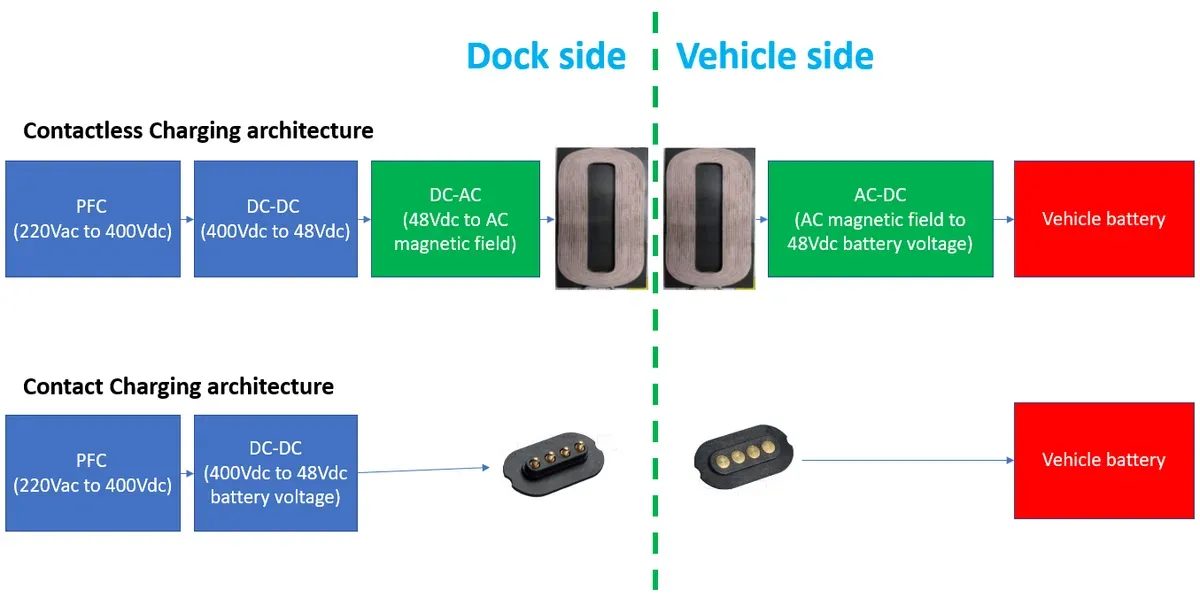
First, consider the architecture of an e-scooter charging dock. As the figure below shows, the difference between contact and contactless charging is the additional contactless power module pair. It brings convenience and reliability, but adds cost and energy loss. Whether contactless charging can replace contact charging therefore depends on designing a low-cost, highly efficient contactless power module pair.
The contactless power module pair converts electrical energy into a magnetic field and back, using the field to transfer power wirelessly. Below we compare a typical high-frequency solution with our approach to wireless power transfer (WPT). Type 1 is a high-frequency resonant WPT architecture; Type 2 is Tseetech’s loosely coupled inductive WPT architecture. Type 1 runs at a fixed frequency, so it needs a pre-regulator ahead of the power amplifier to adjust the field strength, and it usually uses an out-of-band link such as BLE for Tx/Rx communication. Type 2 varies its operating frequency, so no pre-regulator is needed, and Tx/Rx communication runs directly between the coils.
The frequencies available for wireless power transfer are limited. Under the regulations published in each country, three frequency bands are available: 79–90 kHz, 100–148.5 kHz and 6.78 MHz.
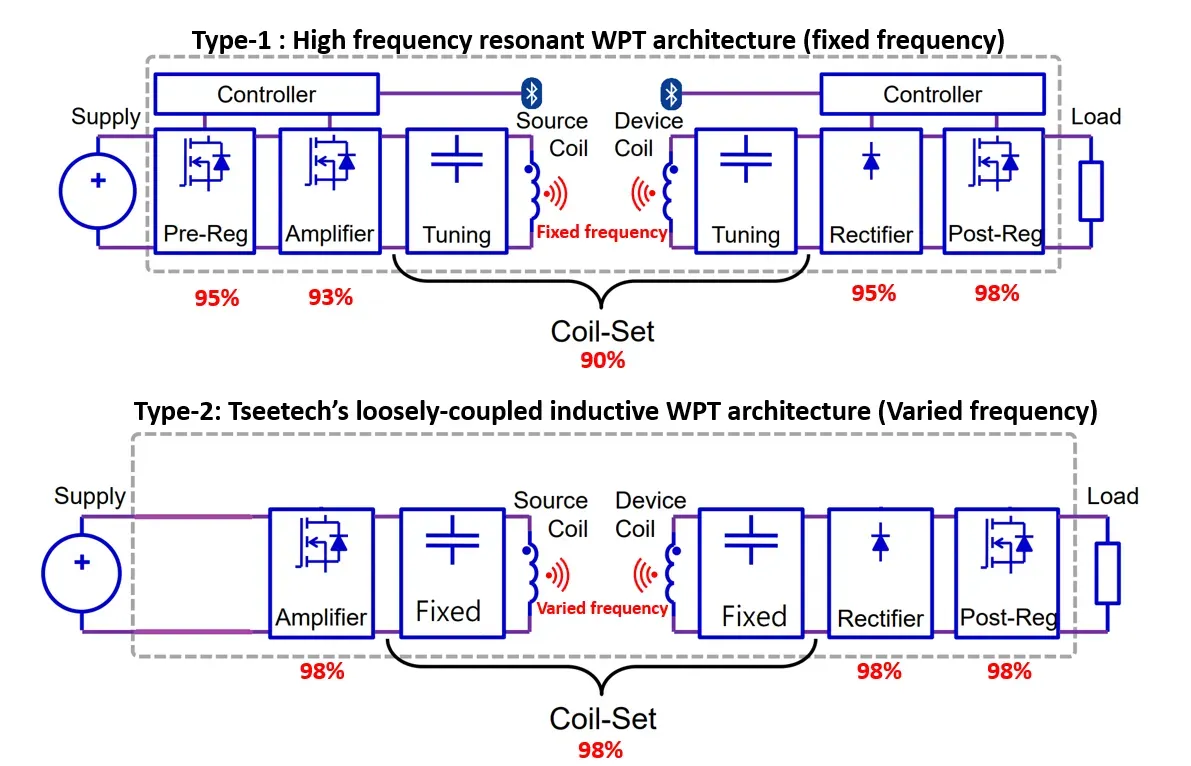
There has long been debate about which band is best for magnetically coupled wireless power transfer. 6.78 MHz heats nearby metal less and needs less coil inductance for long-distance transfer, so Type 1 often uses 6.78 MHz as its fixed frequency. The figure above shows typical high-end efficiencies for each functional block of Type 1; the resulting end-to-end efficiency is at best about 75%, in line with figures published by several resonant WPT companies.
For Type 2, Tseetech uses the 79–90 kHz band, the same band as the international EV wireless charging standard. Through optimization of each block, TE03 reaches up to about 93% end-to-end efficiency.
93% versus 75% makes a large difference in heat. For example, to charge a 48 V (13S) battery at 4 A, the receiver needs to deliver up to 220 W to the load. At 93% the system generates about 16 W of heat; at 75%, about 73 W. If the heat is split equally between the Tx and Rx sides, Type 2 has about 8 W to dissipate on each side and Type 1 about 36 W. Type 1 is therefore much harder to cool and needs active cooling, which adds cost and complexity, while the 8 W in Type 2 can be handled with simple passive cooling, which is more practical for mass deployment.
Some might argue that, physically, long-distance power transfer is harder at lower frequencies. A useful way to look at this is the distance-to-diameter ratio: the maximum coil-to-coil distance at which coil-to-coil efficiency stays above 90%, divided by the coil diameter (assuming equal Tx and Rx coils). At 6.78 MHz this ratio is around 0.5 to 1, depending on the coil topology; at 79–90 kHz it is about 0.3 with Tseetech’s technology. A lower ratio means larger coils for the same distance, which can be a problem for small or light devices such as consumer drones. For e-scooters, however, the larger and heavier coils are not an issue: a coil-to-coil distance of 15–35 mm is enough for a parking dock, and the resulting coil size and height are acceptable.
In this article we have compared high-frequency resonant WPT with Tseetech’s loosely coupled inductive WPT. For e-scooters, the latter is the better fit, and because it needs fewer components it also costs considerably less.
We look forward to working with operators and solution providers to build profitable services on this technology. Contact us to discuss your project.