
Foreign object detection in wireless charging: principles and practice
- # Foreign object detection

Why wireless charging needs foreign object detection
Wireless charging transfers energy through an alternating magnetic field. Mid- and high-power systems typically run at tens to hundreds of kHz — a range in which common metals heat up through eddy currents, the same principle as an induction cooktop. If a coin, key or screw ends up in the charging area, it keeps heating: at best efficiency drops, at worst the equipment is damaged or becomes a safety risk.
For phone chargers, with low power and a small coil gap, detecting metal is relatively easy. At tens of watts up to kilowatts, and with larger gaps, the electrical change caused by a metal object is much smaller, and the detector has to be sensitive without raising false alarms. That makes foreign object detection (FOD) one of the deciding factors for whether a mid- or high-power wireless charging design is ready for real products.
How Tseetech approaches FOD
Tseetech’s foreign object detection combines dynamic frequency sweeping, power and distance sensing, and a neural-network algorithm. It keeps checking for metal in the charging area both in standby and during power transfer: when it finds something, the transmitter stops and raises an alarm; once the object is removed, the system resumes on its own. The technology is covered by four core patents.
Test: FOD on the TD01
The TD01 wireless charging module is used here to show how detection behaves in both states.
Standby. A 19 mm coin placed on the transmitter coil in standby is detected: the indicator turns from blue to flashing red and power transfer does not start.
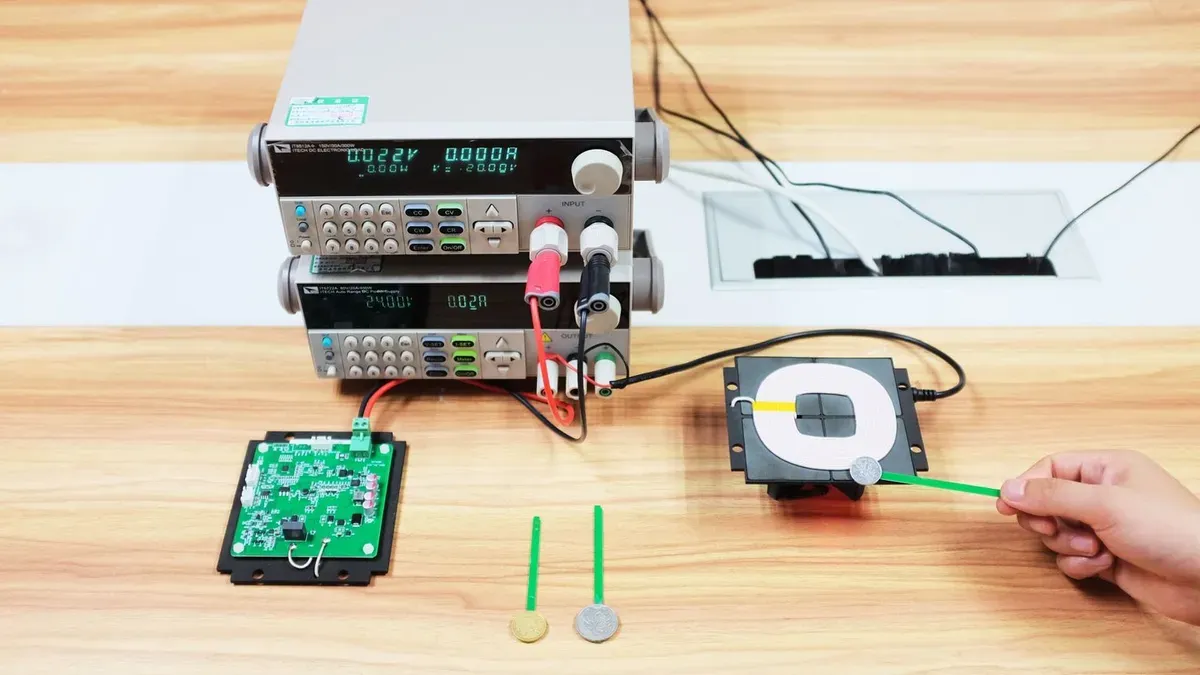
During power transfer. With a 25 mm gap between the transmitter and receiver coils and a DC supply and electronic load connected, the system delivers power normally. When the coin is slipped between the coils, power transfer stops at once and the alarm goes off; after a while the coin has not heated up. Remove the coin and power transfer resumes automatically, with the indicator back to flashing blue.
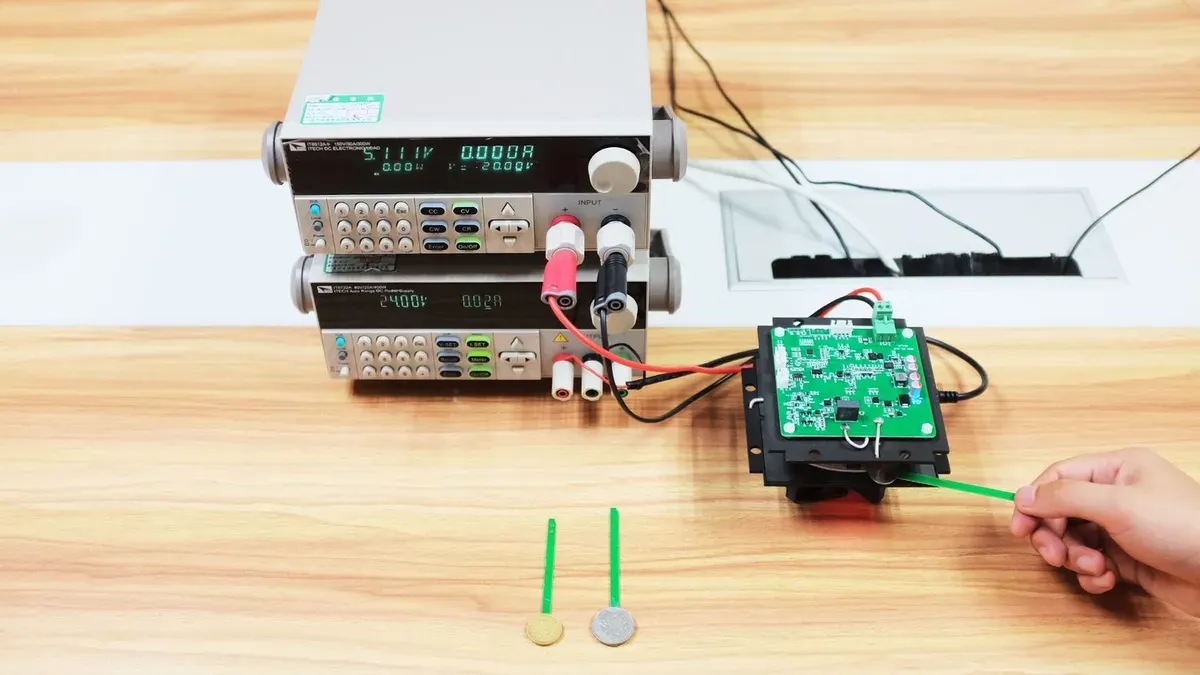
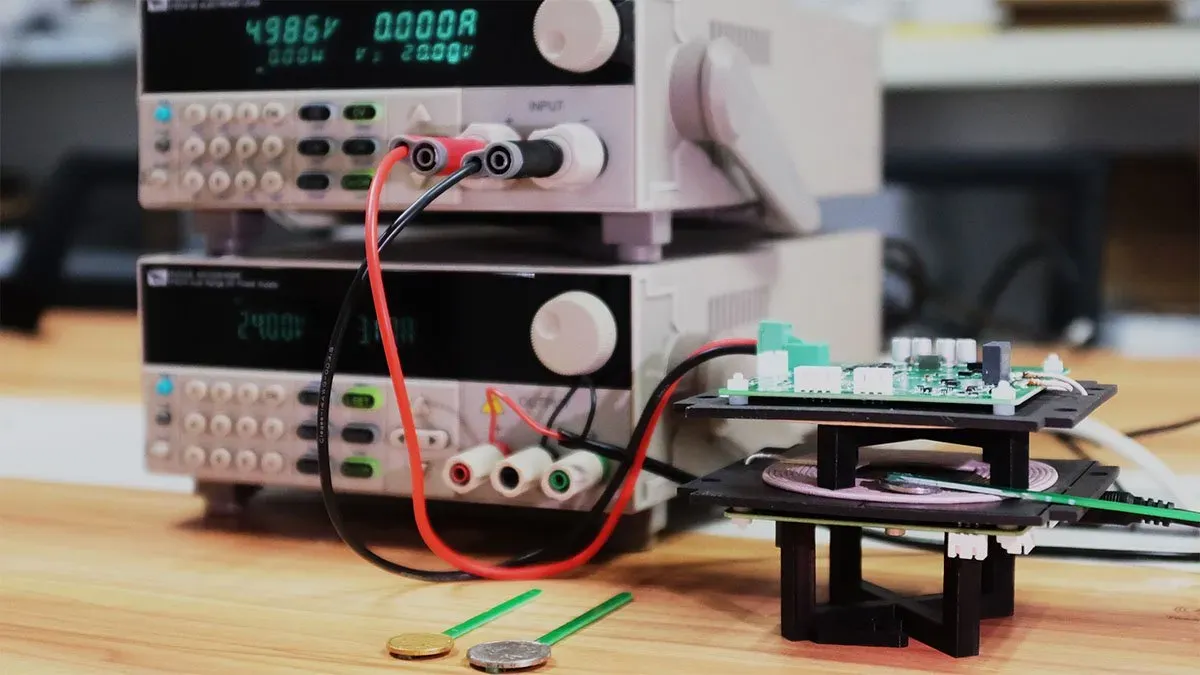
Different coins and gaps. We repeated the test with three coin sizes (small, medium, large) at coil gaps from 15 to 35 mm, in standby and during power transfer. Every combination was detected and triggered protection:
| Coil gap | Standby: S | Standby: M | Standby: L | Transfer: S | Transfer: M | Transfer: L |
|---|---|---|---|---|---|---|
| 15 mm | ✓ | ✓ | ✓ | ✓ | ✓ | ✓ |
| 20 mm | ✓ | ✓ | ✓ | ✓ | ✓ | ✓ |
| 25 mm | ✓ | ✓ | ✓ | ✓ | ✓ | ✓ |
| 30 mm | ✓ | ✓ | ✓ | ✓ | ✓ | ✓ |
| 35 mm | ✓ | ✓ | ✓ | ✓ | ✓ | ✓ |
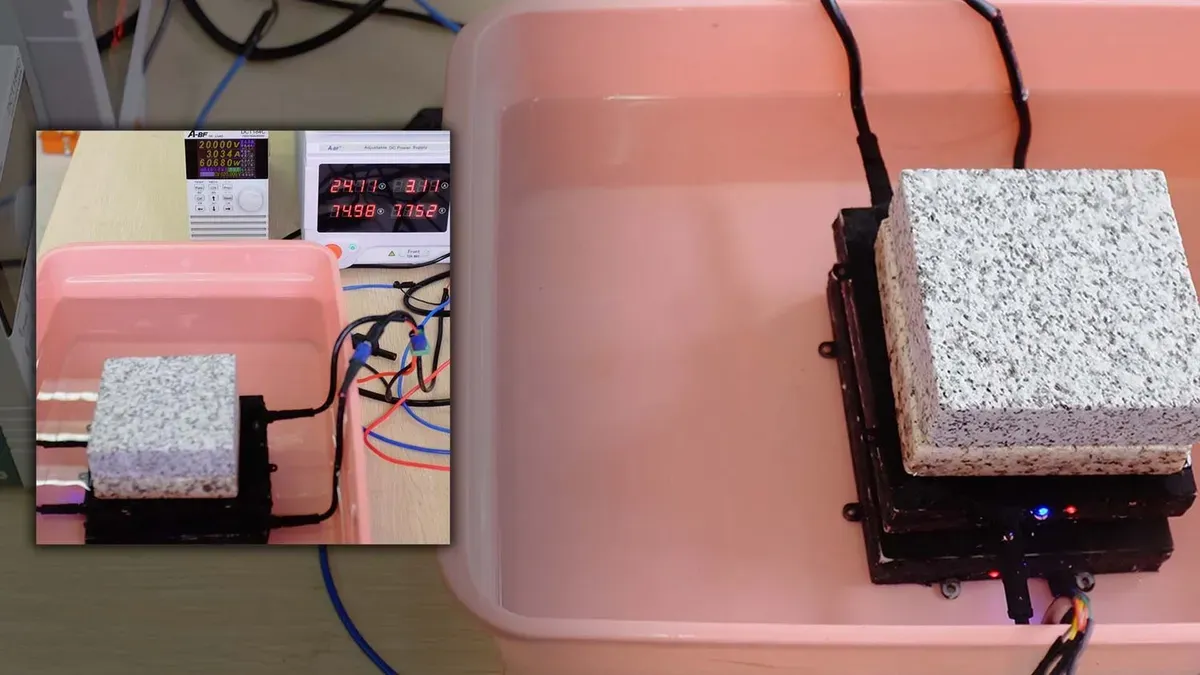
Under water. Beyond FOD, we also ran the TD01 submerged in water; the output stayed stable. This applies to the test conditions described; please assess your own application.
What to check when choosing a solution
FOD is rarely prominent on a datasheet, yet it decides how safe and reliable a mid- or high-power wireless charging system is over time. When selecting a solution, check:
- whether detection works both in standby and during power transfer;
- the smallest object it detects at your real coil gap;
- whether the alarm, shutdown and auto-resume behavior suits how your product is used.
Current TD01 specifications are on the TD01 product page. To evaluate a project, talk to an engineer.