
Coil quality factor Q: definition and typical values
- # Coils & magnetics
The coil is the part of a wireless charging system that actually transfers the energy. One of the most common ways to judge a coil is its quality factor, Q: the ratio between the energy it stores in its magnetic field and the energy it loses as heat.
Definition
A real coil can be modeled as an ideal inductance L in series with an equivalent loss resistance R. That resistance includes the wire’s DC resistance, skin- and proximity-effect losses at high frequency, and losses in magnetic materials and nearby metal.
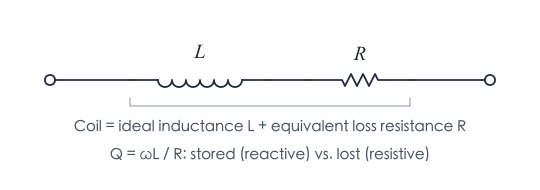
The quality factor is the coil’s reactance divided by its equivalent resistance:
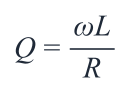
where ω = 2πf is the angular frequency. At a given frequency, more inductance and less loss mean a higher Q.
Typical values
- In theory Q can be anything from zero upward, but real coils rarely exceed about 1,000;
- around 100 is a realistic target for mass-produced wireless charging coils;
- below about 10 the losses are too high for the coil to be of practical use.
These are orders of magnitude; actual values depend on frequency, coil size and manufacturing.
What affects Q
At a fixed operating frequency, Q is set mainly by the coil’s shape, size and materials:
- Wire: Litz wire greatly reduces skin-effect losses at high frequency, while flat copper wire has advantages at high current;
- Magnetic material: a ferrite shield concentrates flux and raises inductance, and keeps the field out of nearby metal where it would cause losses;
- Structure and surroundings: metal housings, batteries and circuit boards near the coil add losses, so Q once installed is lower than when the coil is measured on its own.
What it means when choosing a solution
All else being equal, higher-Q transmitter and receiver coils allow higher transfer efficiency and steadier performance at larger gaps and offsets. When you evaluate a wireless charging solution, look not only at the coil’s stand-alone figures but at how it performs once built into your device next to metal parts. In custom projects, Tseetech designs the coil and shielding together with the device structure.
Further reading: WPC knowledge base — Quality factor