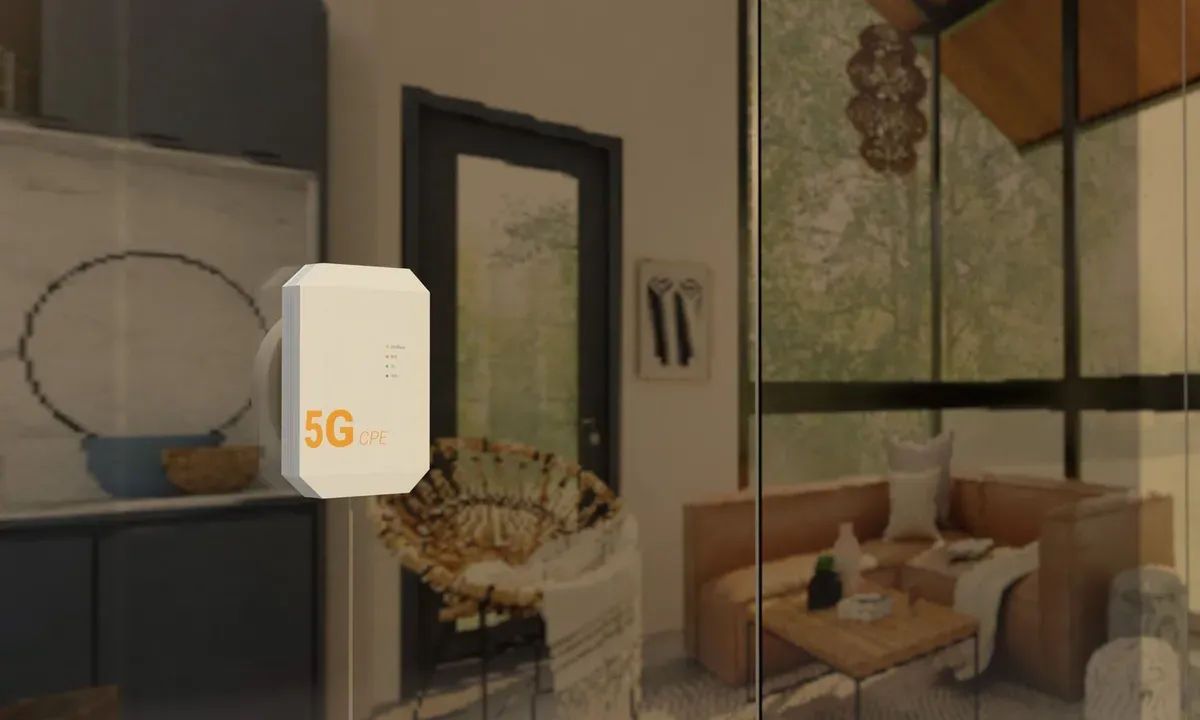
Through-window wireless power for 5G millimeter-wave repeaters
- # Consumer electronics
5G, the hottest topic in the industry over the past few years, is widely seen as a technology that will reshape our world. Many articles describe what 5G can bring; for a comprehensive overview, see https://www.qualcomm.com/research/5g.
To realize the full potential of 5G, operators need higher carrier frequencies, such as the millimeter-wave bands at 28 GHz and 37 GHz. Millimeter-wave signals, however, penetrate obstacles poorly, so operators have to deploy more base stations than in the 4G era. Even so, consumers often get a poor 5G signal at home, because millimeter-wave signals are blocked by walls.
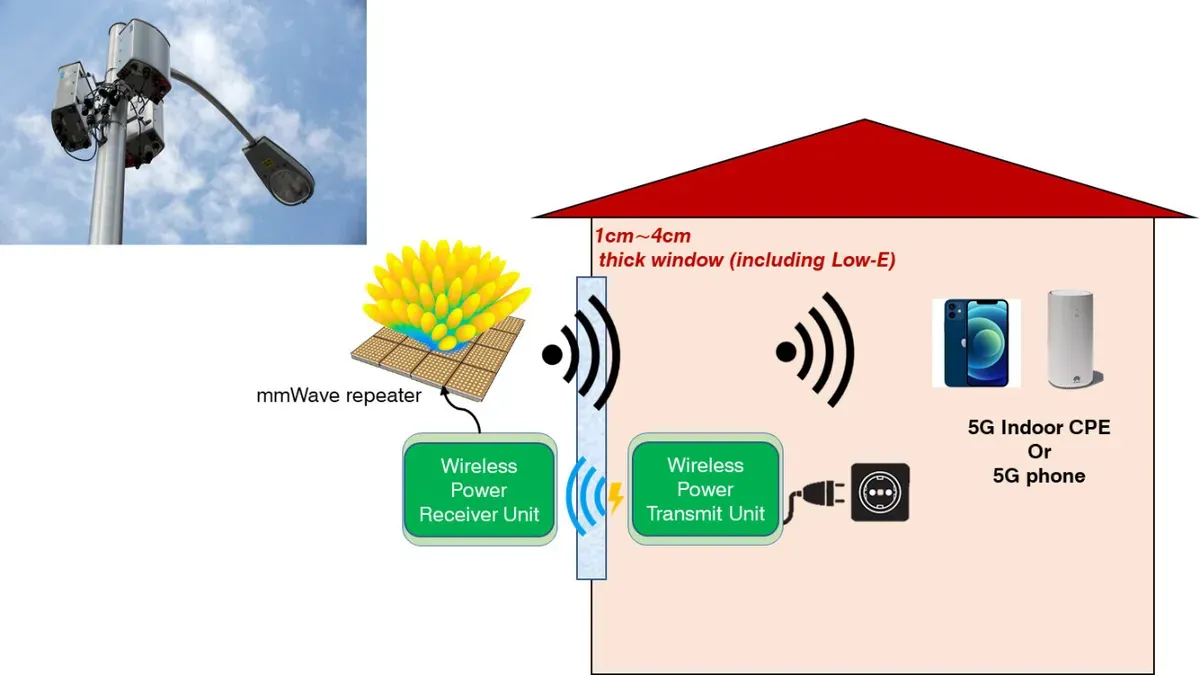
To address this, Pivotal Commware, a start-up backed by Verizon and Bill Gates, has been deploying a 5G repeater since January 2020 (https://olv.duke.edu/news/pivotal-commware-announces-commercial-launch-of-echo-5g/). The repeater is mounted on the outside of a window, where it receives the millimeter-wave signal from the base station well. It then re-amplifies the signal and passes it into the home, so consumers get a full 5G signal on their phones indoors.
One key element was not mentioned in the early 2020 announcement. In May 2021, Pivotal Commware revealed it in EE Times (https://www.eetimes.com/wireless-power-boosts-5g-deployment/#): a through-window wireless power supply powers the repeater mounted on the outside of the window. The figure below shows the idea. This approach makes the whole system self-installable.
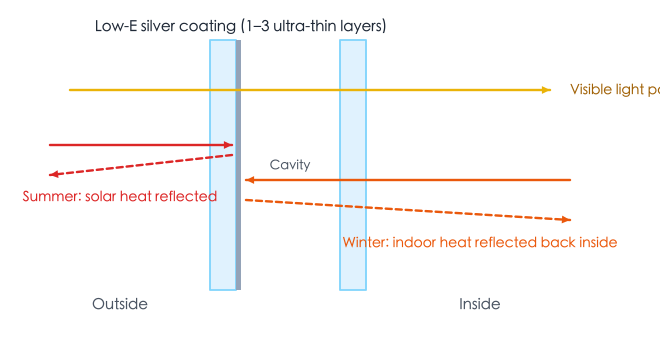
It is worth noting that windows use many types of glass. Low-E (low-emissivity) glass is widely used around the world to make indoor environments more comfortable. It has a microscopically thin, transparent coating, much thinner than a human hair, that reflects long-wave infrared energy (heat); some types also reflect a significant share of short-wave solar infrared energy. In winter, when indoor heat tries to escape to the colder outside, the Low-E coating reflects it back inside, reducing radiant heat loss through the glass. In summer the reverse happens.
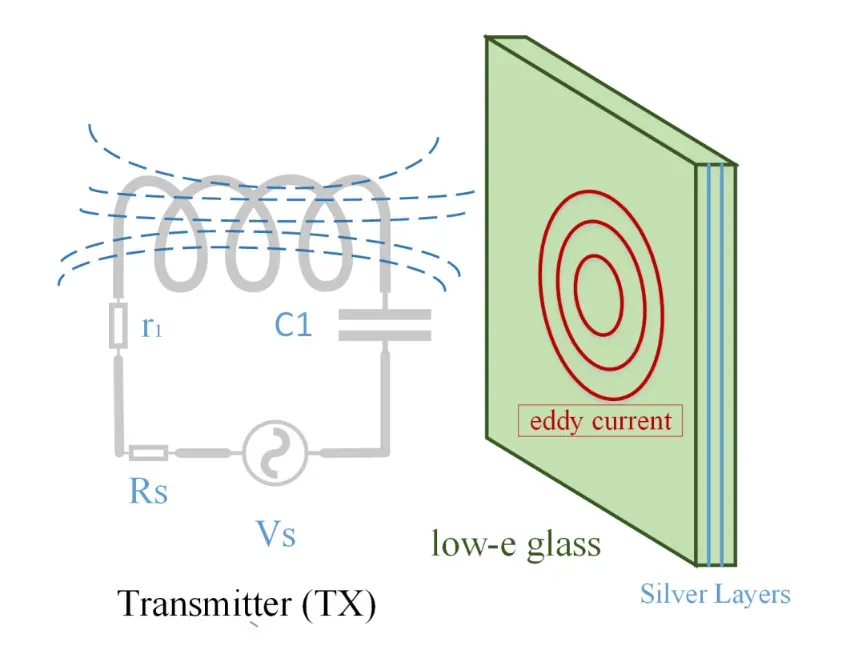
The ultra-thin silver coating in Low-E glass, which can have one to three layers, is a problem for wireless power transfer, as the figure below shows. The magnetic field from the wireless power transmitter induces eddy currents in the thin silver coating, and these currents heat the silver layer. The heat can be high enough to damage the glass. The main challenge for through-window wireless power is therefore making it work across all types of Low-E glass.
The formula below gives the power loss in the silver coating of Low-E glass (https://ieeexplore.ieee.org/document/9055631). The power loss is proportional to the square of the magnetic field frequency, so the lower the operating frequency of the wireless power system, the less heat is generated in the Low-E glass.
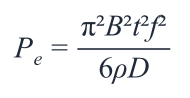
where Pe is the power loss per unit mass (W/kg), B the peak magnetic field (T), t the thickness of the conductive layer (m), f the frequency (Hz), ρ the resistivity (Ω·m) and D the density of the material (kg/m³). It applies to a layer thinner than the skin depth in a uniform field.
Tseetech’s wireless power module operates at 79–90 kHz, the lowest of the wireless power transfer bands permitted in China at the time of writing. As a result, it achieves about 90% end-to-end efficiency even through 3 cm thick Low-E glass with three silver layers, the most demanding window type. Beyond 5G, research on 6G is under way and is expected to use even higher frequency bands, which may make signal penetration into buildings harder still. Through-window wireless power will therefore become more and more important as each new generation of communication arrives.
Tseetech offers a through-window wireless power supply solution. Contact us to discuss your product development.