Wireless charging in furniture: installation and design considerations
- # Consumer electronics
On 14 September 2021, Tim Cook announced the iPhone 13 series. Unsurprisingly, every iPhone 13 model supports Qi and MagSafe wireless charging, making it the fifth consecutive iPhone generation with wireless charging since 2017. There were even rumours that the new iPhone would drop the charging port and rely on wireless charging alone; that did not happen this year, but the iPhone may well become completely port-free one day, in line with Apple’s “the future is wireless” vision.
Apple’s move will speed up the adoption of wireless charging in Android phones. All high-end phones already have it, and more and more mid-range models are adding it. On 30 June 2021, Strategy Analytics predicted that up to 1 billion phones would have wireless charging by the end of 2021. Yet not everyone pays extra for a wireless charger, even when their phone supports it. That creates an excellent opportunity for furniture makers: sofa armrests, side tables and desks with built-in wireless chargers will appeal to consumers whose phones charge wirelessly.
The Swedish furniture giant IKEA pioneered built-in wireless charging as early as 2015. For other furniture, IKEA offered a 5 W wireless charger with a wooden ring, which customers had to install by drilling a hole in the furniture; this was much less popular than its lamps with integrated chargers. After six years of exploration, IKEA launched SJÖMÄRKE, a wireless charger that mounts out of sight, to solve the integration problem.
https://www.ikea.com/us/en/p/sjoemaerke-wireless-charger-80512718/
https://hitechwiki.com/ikea-unveils-a-new-wireless-charger-to-screw-under-the-desk/
This is how IKEA describes the product on its website:
With SJÖMÄRKE wireless charger your technology becomes invisible since you mount the charger hidden – for example under a tabletop or shelf. Works through all materials except metal.
Perfect to mount on a desk, side table or bedside table when you want chargers and cables to blend into the decor to keep the room neat and tidy.
In other words, the furniture maker with the most experience of wireless charging integration has endorsed through-surface charging as the right approach for its customers. Before this announcement, through-surface charging was used mainly in public charging spots, because it is convenient for operators. Now it is clear that individuals, not just shared-charging operators, want hidden chargers that keep their homes tidy.
IKEA’s hidden charger delivers 5 W through surfaces 8 mm to 22 mm thick and sells for 39.99 USD. This sets a benchmark for other furniture makers: those who can deliver more power across a wider range of surface thicknesses at a similar or lower price may win this promising market faster.
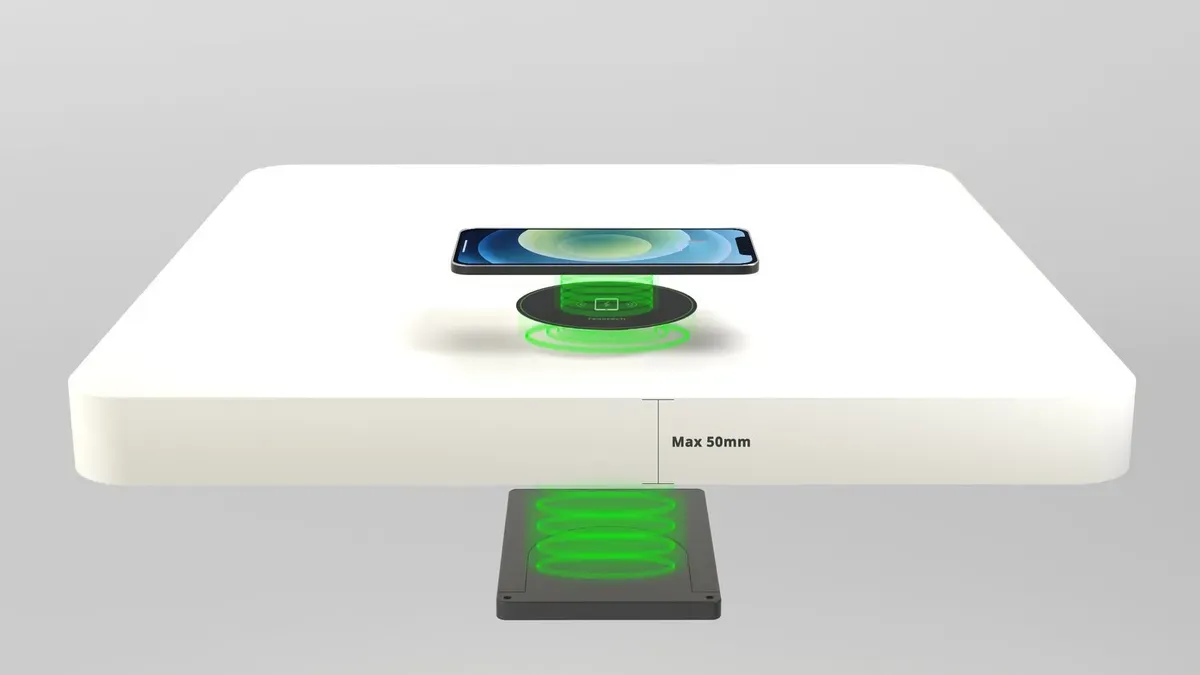
Tseetech’s through-surface charging technology covers surface thicknesses from 8 mm to 50 mm. If you want to sell a product similar to IKEA’s SJÖMÄRKE, our QB06 charges iPhones at 7.5 W and Samsung phones at 10 W across the same range of surface thickness. If you want to go further, our QB21 charges iPhones at 7.5 W and Samsung phones at 10 W through surfaces 20 mm to 50 mm thick. With this product range, most furniture can integrate wireless charging without difficulty.
Contact us for a quotation for your furniture project.